

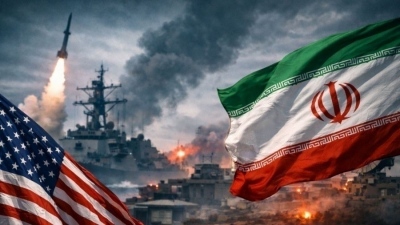
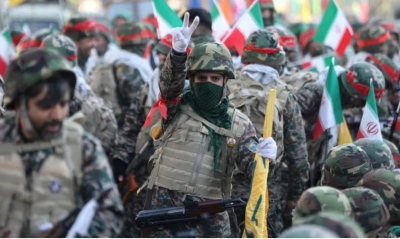
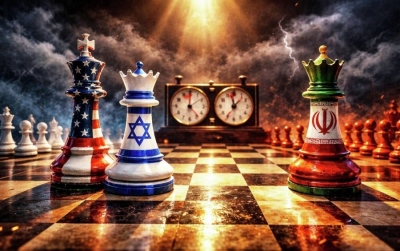
Assessing the events in the Persian Gulf and the raw attack by Americans and Israelis against Iran with composure, the conclusion is clear: the Americans are not winning and Iran is not losing. US President Donald Trump has realized that this entire situation is a dead end. He is searching for an exit strategy that preserves US prestige and avoids causing chaos among the Persian Gulf monarchies, which realized too late that American bases are a cause of trouble rather than a deterrent. When American generals urged Trump to withdraw from the Gulf, the President devised a clever plan for a "disengagement coalition." He sought to involve other countries so the US would not bear the weight of failure in the Strait of Hormuz, which is now fully controlled by the Iranians and the Islamic Revolutionary Guard Corps (IRGC). The Americans do not need Europe's "rusty ships," but they needed Europe and NATO as a collective body to facilitate their disengagement—but a "treacherous Europe" sold Trump out.
Treacherous Europeans abandon Trump
Trump's European allies are silently celebrating. There is much discussion right now about the fact that Trump is publicly asking NATO countries to join a "disengagement coalition" and send their warships and technical vessels to clear mines in the Strait of Hormuz. He is also calling for further escorts for commercial vessels currently gathered at their positions within the oil monarchies of the Persian Gulf.
Trump escalates, ready to show his wrath to the Europeans
Trump began in a relaxed manner, suggesting that interested countries ensure the security of passage for their own ships (with his help), because "this was always a collective effort." There was no response, and Trump began to get nervous: "Many countries, particularly those affected by Iran's efforts to close the Strait of Hormuz, will send their warships along with the United States of America."
The seven countries are missing—a grim future for NATO
He then added that discussions on this matter were already underway "with seven countries." But silence prevailed again, and Trump sensed something was wrong: "NATO faces a very grim future if its allies do not help open the Strait of Hormuz—a critical oil transit route that has essentially been blocked by Iran."
Trump: "They don't help us in the difficult times"
"We were not obligated to help them with Ukraine. Now we will see if they help us. I have been saying it for a long time: we will be there for them, but they won't be there for us. And I'm not sure they will be." The Europeans and other allies did not realize Trump was furious; instead, they decided to exploit the difficult US position in Iran to take revenge for their past humiliations.
Europeans avenge Trump's humiliations—Greece says no
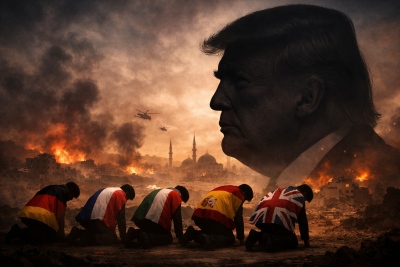
The British Prime Minister stated that "we will not be dragged into a wider war" and expressed a desire to end the Iranian conflict as soon as possible. Interestingly, he retreated immediately after news broke that Britain was allegedly planning to send mine-clearing drones to the region. The German Defense Minister also stated that "this is not our war, we didn't start it," and said Germany refuses to participate in Trump’s proposed operation to ensure security in the Strait of Hormuz. France confirmed that "Paris has only a defensive position, no ships; the war with Iran is not ours." Italy, Australia, South Korea, Japan, and Greece categorically refused in much the same spirit.
The European Union says "we will let you know"—only tiny Estonia offers help
The European Union decided to play it safe: EU foreign policy chief Kaja Kallas announced that EU foreign ministers are feverishly discussing the possibility of sending European warships to the Strait of Hormuz, but they will decide "in due course." Help for Trump came from an unexpected source: the Baltic tiger, Estonia. The Estonian Foreign Minister stated that "Estonia could send warships to the Strait of Hormuz to help the US Navy," but added, "we need to know the goals and plans for the region."
Treacherous Europeans missed Trump's trick
None of the European politicians—who are not known for their intellect—realized that Trump did not actually need their help. The power of the US Navy is much greater than that of the rest of the world combined. They did not understand that Trump simply needed someone to share the responsibility and that purely symbolic steps would have sufficed. Instead, Trump was openly humiliated and lost his prestige. Worse for Trump, he lost this prestige before a scheduled meeting with the Chinese President, and there are now reports that the Americans may postpone the trip to China.
Malignant narcissist and egomaniac
Those who professionally study Trump understand how significant this is. Trump is a "malignant narcissist" and "egomaniac," and for him, personal humiliation is a million times more important than national interests or party approval ratings. For example, he abolished Obamacare simply because he disliked Obama. He purged Republicans who publicly criticized him, causing a rift within the Republican Party. Recently, he "expelled" journalist Tucker Carlson from the MAGA movement for calling the attack on Iran "horrific" and suggesting Netanyahu dragged Trump into the war. Breaking with Carlson could mean losing the "core" ideological base that helped him return to power.
"We will remember this"
But Trump does not care. After his allies refused to cooperate on disengaging the Strait of Hormuz, he wrote: "Whether we get support or not, I assure you—and I have conveyed this to them—that we will remember this." These are not just words.
Trump knows how to take revenge on Europe
Trump has clearly heard rumors that the Europeans abandoned him after the Iranian adventure, and he will almost certainly try to prove they rejected him too early. He knows the sensitive spot of the "Russophobic" EU—Ukraine—and we will now see how Trump takes his revenge: with pleasure and without haste. Russia is rubbing its hands and waiting with remarkable patience.
The world after Iran
It appears that the war in the Middle East, for which neither Israel nor the US was prepared but for which Iran was fully ready, marks the turning point of the Trump administration's essentially imperial strategy. By limiting the globalization of the last 40 years, America began building a vertical power structure centered exclusively on America, where everyone else is treated equally, whether friends or "pariahs."
Many missed the clear messages of the new National Security Strategy
According to Trump's National Security Strategy, ideology was sidelined from foreign policy, though it was kept for emergencies—like current calls for Iranians to take to the streets and overthrow the "regime."
A steep path
In its attempt to carve out a distinct place for America in the new world order, the Trump administration initially relied on imposing tariffs to fund American re-industrialization. This takes time and, meanwhile, fuels inflation. But time is running out—the midterm Congressional elections are scheduled for November 3, 2026. Furthermore, the Supreme Court ruled that the administration had usurped Congress's fiscal prerogatives. The focus then shifted to transforming the US into a dominant energy power. This required an aggressive foreign policy. Efforts to control resources in Greenland and Canada failed immediately, as both invoked their sovereignty. Sovereignty was easier to bypass in Venezuela, where the "dictatorship" was cited to establish control over oil. At the same time, the Rubio-led State Department saw opportunity in the Western Hemisphere, but extending that experience to a different culture led to disaster.
Aggression against Iran was a terrible trap
The essence of the disaster in Iran is that there was no plan for a protracted military operation. Ammunition proved insufficient. Aircraft carriers—one returned for repairs, one withdrew, and a third "disappeared in the fog"—proved to be weapons of colonial war with ranges too short to risk against modern defenses. Regional powers, Europeans, Turkey, and Azerbaijan refused to join a war that wasn't theirs. Consequently, plans for a ground operation collapsed, and even the Kurds refused to participate.
Americans underestimated Iran's preparation and resolve
Currently, everything has culminated in the closure of the Strait of Hormuz, which the US cannot unblock. Therefore, Trump has suggested that the affected countries—including China, Japan, and European allies—handle it themselves. Iran is currently conducting these negotiations with each country individually. Iran, where decision-making has shifted to security forces, is far more determined now than in June 2025. The US is using rhetoric as cover for a "soft" disengagement. Strikes against Iran have no prospect, especially since Iran has been given a "blank check" to destroy US bases and show that being a US ally is dangerous.
Iran has taken the initiative
One cannot but agree that the strategic initiative has shifted to Iran. The opening of the Strait of Hormuz depends on Iran, which has played its cards skillfully. Space and time are not on the side of the US and Israel. The generalized statements of the "unacceptable" Netanyahu regarding Israel becoming a global superpower are empty words that cost Israeli citizens dearly.
Turning to theology and the "Second Coming"
It is not surprising that by the seventh day, the White House turned to God, introducing religious eschatology into the conflict (the "Christian Zionist" wing’s intent to force the Second Coming by creating a "Greater Israel"). By the tenth day, Trump called the Kremlin.
The Middle East conflict as a boomerang
A foreign policy disaster of this scale could cost the entire Republican administration dearly. Trump’s scheduled visit to China on March 31 may be postponed to avoid humiliation. Most importantly, the "deep state" will not forgive Trump for a stock market collapse, potentially dictating a quick end to the conflict—even if it means leaving Israel behind. The MAGA movement must return to its roots, a sentiment expressed by J.D. Vance. The fate of the conservative revolution is now a factor of geopolitical uncertainty.
Pax Americana was collapsing
The post-war international legal order has been eroded by the West, first under ideological slogans and then, under Trump, by absolute arbitrariness. Simultaneously, Pax Americana was collapsing. Trump, according to some Americans, is a "born destroyer." International law, the result of two world wars, has been discarded. The new multipolar world order promises to be cross-cultural. What was called a "deal with the devil" has exhausted its resources, and the continuation of Western hegemony is becoming a threat to humanity itself. The concept of progress requires a collective reformulation based on the world's accumulated experience.
www.bankingnews.gr



Σχόλια αναγνωστών